Driving in France from the UK
 A. FruchardCo-founder & CEOLast updated: 8 November 2026
What do you need for driving in France from the UK?
Driving in France from the UK takes a photocard licence, your log book (V5C) or a VE103 for a hire car, a UK sticker unless your plate already shows the UK identifier, a reflective vest and a warning triangle. A Crit'Air sticker is needed only in low-emission zones, and an IDP is not needed.
Each rule below was read on the official page that sets it, on 1 November 2026: GOV.UK for what a British driver must carry, and the French government's Service-Public site for the kit, the speed limits, the fines and the tolls. Where a figure is in euros it is followed by its value in pounds, because French fines are set and paid in euros.
The French rules reach you in three layers. The first is what you carry in the car, which is the same on every trip. The second is what the road asks of you, such as speed limits and the drink-drive limit. The third is what depends on where and when you drive: a low-emission zone, a toll section, or a mountain road in winter.
- UK photocard licenceGreat Britain or Northern IrelandWhat the official page saysYou can use a UK photocard driving licence to drive in FranceWhere it comes fromGOV.UK, France travel advice
- Paper licenceOlder style of licenceWhat the official page saysYou may need to update it to a photocard licence or get the correct version of the international driving permit as wellWhere it comes fromGOV.UK, France travel advice
- Log book (V5C)Your own carWhat the official page saysTake it with you if you are taking your own vehicle, together with your insurance certificateWhere it comes fromGOV.UK, Driving abroad
- VE103 certificateHired or leased in the UKWhat the official page saysNeeded for a vehicle you have hired or leased in the UK and take abroadWhere it comes fromGOV.UK, Driving abroad
- UK stickerOn the rear of the carWhat the official page saysNot needed if your plate shows the UK identifier with the Union flag; needed with any of the other plate designsWhere it comes fromGOV.UK, Displaying number plates
- International driving permitIDP type for France: 1968What the official page saysYou do not need an IDP; check the car hire company if you are hiringWhere it comes fromGOV.UK, IDP country table
What to carry | What the official page says | Where it comes from |
|---|---|---|
UK photocard licence Great Britain or Northern Ireland | You can use a UK photocard driving licence to drive in France | GOV.UK, France travel advice |
Paper licence Older style of licence | You may need to update it to a photocard licence or get the correct version of the international driving permit as well | GOV.UK, France travel advice |
Log book (V5C) Your own car | Take it with you if you are taking your own vehicle, together with your insurance certificate | GOV.UK, Driving abroad |
VE103 certificate Hired or leased in the UK | Needed for a vehicle you have hired or leased in the UK and take abroad | GOV.UK, Driving abroad |
UK sticker On the rear of the car | Not needed if your plate shows the UK identifier with the Union flag; needed with any of the other plate designs | GOV.UK, Displaying number plates |
International driving permit IDP type for France: 1968 | You do not need an IDP; check the car hire company if you are hiring | GOV.UK, IDP country table |
Every guide on hellosafe.co.uk is written from official sources: GOV.UK and the Foreign, Commonwealth & Development Office, and the embassies and immigration services of each destination. Each fact is checked on the date shown under its table, and the page is updated when a rule changes. No airline, tour operator or visa service pays for a place in our guides.
Learn moreWhich compulsory kit must you carry in your car in France?
Two items are compulsory: a high-visibility vest and an advance warning triangle. The French Service-Public page on mandatory equipment says you must have both on board to drive, and that you must be able to show them at a roadside check. Not showing them immediately is punishable by a fine of up to €38 (about £32).
The vest must carry the CE marking and be stored at hand. The triangle must be approved and be kept in the car. GOV.UK says the same thing from the British side: a reflective jacket and a warning triangle are needed in many countries, and if you hire a car it is your responsibility to check the car has the equipment you need.
- High-visibility vestCE marking, within reachWhat Service-Public saysCompulsory to drive; wear it if you must leave a stopped car on the road or its surroundingsPenalty it givesUp to €38 (about £32) if not shown at a check
- Warning triangleApprovedWhat Service-Public saysCompulsory to drive; keep it in the car; place it 30 metres or more behind the car when a stop is a dangerPenalty it givesNot wearing the vest or not signalling a car stopped on the road: up to €750 (about £630)
- LightsDipped and main beam, position, rear fog, indicators, brake lights, hazard lights, rear plate lightWhat Service-Public saysMust all work; replace a faulty bulb at once; carrying spare bulbs is recommendedPenalty it givesUp to €450 (about £380)
- TyresConditionWhat Service-Public saysDriving on tyres in poor condition is forbiddenPenalty it givesUp to €750 (about £630)
- WindscreenWiper and washerWhat Service-Public saysAt least one working wiper and a washerPenalty it givesUp to €450 (about £380)
- HornApprovedWhat Service-Public saysEvery car must have onePenalty it givesUp to €450 (about £380)
- BreathalyserWhat Service-Public saysNot compulsory in the carPenalty it givesNone
- Radar detectorWhat Service-Public saysForbidden to hold, carry or usePenalty it givesUp to €1,500 (about £1,250)
Item | What Service-Public says | Penalty it gives |
|---|---|---|
High-visibility vest CE marking, within reach | Compulsory to drive; wear it if you must leave a stopped car on the road or its surroundings | Up to €38 (about £32) if not shown at a check |
Warning triangle Approved | Compulsory to drive; keep it in the car; place it 30 metres or more behind the car when a stop is a danger | Not wearing the vest or not signalling a car stopped on the road: up to €750 (about £630) |
Lights Dipped and main beam, position, rear fog, indicators, brake lights, hazard lights, rear plate light | Must all work; replace a faulty bulb at once; carrying spare bulbs is recommended | Up to €450 (about £380) |
Tyres Condition | Driving on tyres in poor condition is forbidden | Up to €750 (about £630) |
Windscreen Wiper and washer | At least one working wiper and a washer | Up to €450 (about £380) |
Horn Approved | Every car must have one | Up to €450 (about £380) |
Breathalyser | Not compulsory in the car | None |
Radar detector | Forbidden to hold, carry or use | Up to €1,500 (about £1,250) |
Two lines of the table surprise British drivers. A breathalyser is not compulsory in France, so you do not need to buy one before you go. A radar detector is the opposite: it is forbidden to hold, carry or use one, the device is seized, and the car can be seized too if it is fitted to it.
GOV.UK also lists headlight converter stickers among the items you may need abroad, depending on the country, and says emission stickers may have to be bought weeks before you go. The GOV.UK driving abroad page is the place to start for the list as a whole, and our driving abroad guide compares the rules of other countries.
When do you put on the vest and set up the triangle?
You put the vest on when an emergency stop forces you to leave your car on the road or beside it, and you set the triangle when the stopped car is a danger to other traffic. Service-Public gives places close to junctions, bends, hilltops and level crossings, and places with insufficient visibility, as examples.
The triangle goes 30 metres or more behind the car, with the hazard lights on. You are not obliged to place it if doing so could put your life at risk, which is the judgement call on a busy road. On a motorway, GOV.UK says to use the orange emergency phones to ask for help if you are in or witness an accident. GOV.UK gives 112 as the number to call if it is not safe to proceed.
- Before you leave the car
Put the vest on if you must get out onto the road or its surroundings. - Hazard lights
Switch them on as soon as you stop. - Triangle
Place it 30 metres or more behind the car, unless that would put you in danger. - Ask for help
On a motorway use the orange emergency phones; if it is not safe to proceed, call 112.
What are the speed limits when driving in France?
The standard limit is 130 km/h on a motorway, 110 km/h on a dual carriageway separated by a central barrier, 80 km/h on a two-way road without a central divider and 50 km/h in a built-up area. These are Service-Public's general figures for a driver with a full licence, in dry weather, and the local authority can lower any of them.
The limits fall when it rains, and they fall again when you cannot see far. Service-Public lists a lower figure in rain or other precipitation for the faster types of road, and a single figure of 50 km/h on every road when visibility is under 50 metres. The figures are in kilometres per hour: 130 km/h is about 80 mph.
- MotorwayDry weather130 km/hRain or other precipitation110 km/hVisibility under 50 metres50 km/h
- Dual carriageway with a central barrierDry weather110 km/hRain or other precipitation100 km/hVisibility under 50 metres50 km/h
- Road with at least 2 lanes in the same directionDry weather90 km/hRain or other precipitation80 km/hVisibility under 50 metres50 km/h
- Two-way road without a central dividerDry weather80 km/hRain or other precipitation80 km/hVisibility under 50 metres50 km/h
- Built-up areaDry weather50 km/hRain or other precipitation50 km/hVisibility under 50 metres50 km/h
Type of road | Dry weather | Rain or other precipitation | Visibility under 50 metres |
|---|---|---|---|
Motorway | 130 km/h | 110 km/h | 50 km/h |
Dual carriageway with a central barrier | 110 km/h | 100 km/h | 50 km/h |
Road with at least 2 lanes in the same direction | 90 km/h | 80 km/h | 50 km/h |
Two-way road without a central divider | 80 km/h | 80 km/h | 50 km/h |
Built-up area | 50 km/h | 50 km/h | 50 km/h |
The page adds two rules that matter to a long drive. You must adapt your speed to the road, the traffic and the weather, and reduce it in bends, fast descents, narrow roads and wherever the road is not clearly free or may be slippery. On a motorway, if you use the leftmost lane in fluid traffic and good weather you must drive at 80 km/h or more.
Read the signs rather than trust memory: because the local authority can lower these speeds, a sign showing a lower figure than the table is the one that applies. The Service-Public speed page has the full text in English, translated automatically from French.
How much is a speeding fine in France?
A speeding fine starts at €68 (about £57) and rises with the speed over the limit. Service-Public gives a flat-rate fine from €68 for a limit above 50 km/h when you are less than 20 km/h over it, and from €135 (about £110) in every other case, up to the point where speeding becomes an offence.
GOV.UK warns that police give you on-the-spot fines for driving offences, including speeding.
- Less than 20 km/h over, limit above 50 km/hWhat Service-Public saysFlat-rate fine from €68 (about £57)
- Less than 20 km/h over, limit 50 km/h or belowWhat Service-Public saysFlat-rate fine from €135 (about £110)
- 20 to 29 km/h overWhat Service-Public saysFlat-rate fine from €135 (about £110)
- 30 to 49 km/h overWhat Service-Public saysFlat-rate fine from €135 (about £110); the licence can also be suspended for up to 3 years and a road safety awareness course ordered, at your expense
- 50 km/h or more overWhat Service-Public saysAn offence: up to 3 months in prison and a fine of up to €3,750 (about £3,130); the vehicle can be immobilised and impounded
Speed over the limit | What Service-Public says |
|---|---|
Less than 20 km/h over, limit above 50 km/h | Flat-rate fine from €68 (about £57) |
Less than 20 km/h over, limit 50 km/h or below | Flat-rate fine from €135 (about £110) |
20 to 29 km/h over | Flat-rate fine from €135 (about £110) |
30 to 49 km/h over | Flat-rate fine from €135 (about £110); the licence can also be suspended for up to 3 years and a road safety awareness course ordered, at your expense |
50 km/h or more over | An offence: up to 3 months in prison and a fine of up to €3,750 (about £3,130); the vehicle can be immobilised and impounded |
Fines for speed are set in euros, so the pound figures above move with the exchange rate. We converted them at the European Central Bank reference rate of 0.8338 pounds to the euro, published on 30 October 2026, the latest available when we checked. The figure in euros is the one that counts at the roadside.
What is the drink-driving limit in France?
The limit is 0.5 grams of alcohol per litre of blood, according to Service-Public, and 0.2 for a driver on a probationary licence. GOV.UK says the French legal alcohol limit is a third lower than the limit for England and Wales.
GOV.UK adds that police regularly carry out roadside checks for alcohol and drugs, and that the penalties include fines, loss of licence and prison. The sensible rule is to decide who drives before the first drink.
- The limit
0.5 g/l of blood, which GOV.UK says is a third lower than the limit for England and Wales. - Checks
Police regularly carry out roadside checks for alcohol and drugs. - Penalties
GOV.UK lists fines, loss of licence and prison. - A breathalyser
Not compulsory in the car, and no substitute for planning who drives.
Do you need a Crit'Air sticker in France?
Only in a low-emission zone or during a pollution alert, not for the country as a whole. GOV.UK says all vehicles driving in central Paris, Lyon and Grenoble must display a pollution sticker from 8am to 8pm, Monday to Friday, that checks can happen at any time depending on pollution levels, and that other cities may also limit vehicle access.
GOV.UK says emission stickers may need to be bought weeks before you go abroad. The cities, the classes and the ordering have their own page: see our guide to the Crit'Air sticker for UK drivers.
How do tolls work on French motorways?
Some French motorways have no toll barrier at all. On a free-flow section, overhead gantries calculate the toll as you pass, and you have 72 hours to pay. Service-Public lists the A79 in the Allier, the A13 and A14 between Paris and Normandy, and exit 36 of the A4 at the Boulay toll as free-flow.
The ministry contrasts this with the older way of paying directly at a toll barrier. Neither official page lists every motorway, so check the signs and the operator's website for the section you will use. On a free-flow section there is no barrier to stop you, so the payment is yours to remember within the 72 hours.
- Online, on the motorway operator's websiteWhat Service-Public saysFrom a customer account if you have one, or directly without an account. Sanef runs the A13, A14 and A4 section; Aliae runs the A79
- In a tobacconist or newsagentWhat Service-Public saysBy card or cash, in a shop in the Nirio network
- With an electronic toll tagWhat Service-Public saysNothing to do if the tag is correctly fitted: the amount is debited automatically
- Payment notice, if you do not pay in 72 hoursWhat Service-Public saysThe toll plus a lump sum of €90 (about £75), reduced to €10 (about £8) if paid within 15 days; after 2 months, the lump sum plus €375 (about £310)
How you pay on a free-flow section | What Service-Public says |
|---|---|
Online, on the motorway operator's website | From a customer account if you have one, or directly without an account. Sanef runs the A13, A14 and A4 section; Aliae runs the A79 |
In a tobacconist or newsagent | By card or cash, in a shop in the Nirio network |
With an electronic toll tag | Nothing to do if the tag is correctly fitted: the amount is debited automatically |
Payment notice, if you do not pay in 72 hours | The toll plus a lump sum of €90 (about £75), reduced to €10 (about £8) if paid within 15 days; after 2 months, the lump sum plus €375 (about £310) |
Service-Public also warns that fraudulent messages demanding urgent payment have appeared since free-flow started, and says not to reply to them. Pay only on the operator's official website, in a Nirio shop, or with a tag. The operator's website also offers a service that tells you when a toll is due, if you give your registration number, your email address and the motorways you used.
This guide gives no toll price for a route. We did not retrieve an official price list for the whole network, and a figure copied from elsewhere would go out of date. The Service-Public page on free-flow tolls links to each operator's payment site.
Do you need winter tyres or chains in France?
In some mountain areas, yes, between 1 November and 31 March. GOV.UK says vehicles driven in certain mountain regions in that period must be fitted with winter tyres or chains, and that you could be fined if you do not comply. Service-Public gives the same dates, 1 November to 31 March, for the mountain municipalities concerned.
Service-Public sets out the detail. Winter tyres must carry the alpine symbol together with the letters M+S, M.S or M&S. A tyre marked only M+S, M.S or M&S, without the alpine symbol, can still be used, but then you must also carry chains in the affected areas. Snow chains can be metal chains or an equivalent removable anti-slip device, such as snow socks.
- Winter tyres
Look for the alpine symbol plus M+S, M.S or M&S on the sidewall. - Tyres with M+S only
Allowed, but carry chains too in the areas concerned. - Mountain roads in winter
GOV.UK says conditions can quickly become difficult, so carry water, food, warm clothing and medicines in the vehicle.
Which communes the rule covers is for the French authorities to say. GOV.UK points to the French public services website for what type of vehicle it applies to, what type of tyre or chain to fit, and where in France the rules apply, so check it before a ski trip.
What does GOV.UK advise for safety on French roads?
GOV.UK's advice is practical. On a long drive, plan the journey, allow for unknown roads, weather and tiredness, and take regular breaks. It points to the Bison Futé website for road safety information and traffic black spots, and to Motorways Radio on 107.7 FM, in French and in English, for real-time traffic conditions.
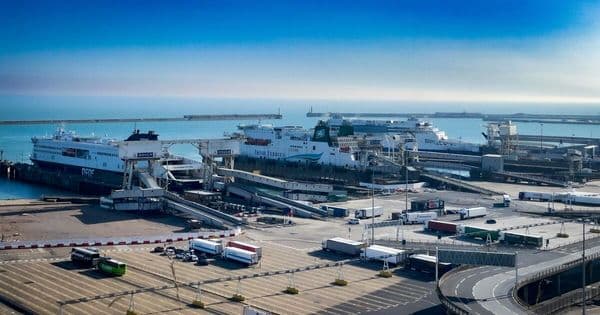
It also describes a risk near the ports. People have tried to enter private vehicles in order to reach the UK illegally, targeting camper vans in particular when stationary or in slow-moving traffic, and sometimes slowing traffic on the roads to the ports, including by placing obstacles on the Calais port road. GOV.UK says to keep the doors locked, keep moving where it is safe to do so and not leave the vehicle unattended, and if it is not safe to proceed, to stop and call 112.
If you are crossing by sea, our ferry to France guide lists the routes, crossing times and check-in times, and the ports where the road matters most.
- Doors locked
In slow-moving traffic, and when the car is left unattended. - Do not leave valuables in the vehicle
GOV.UK lists this among its steps against theft. - Plan breaks
Take them regularly on a long drive.
What changes if you hire a car or hold a Blue Badge?
GOV.UK says hire car companies often have stricter requirements for their customers, such as a year of driving experience, a higher minimum age and holding an IDP, so read your rental terms before you rely on the rules above. It also says your hire company may ask for your driving licence information, which you can share with a licence check code obtained up to 21 days before the trip.
A Blue Badge holder may be able to use the badge in France in some circumstances, and GOV.UK tells you to check the local parking rules before you park. The GOV.UK IDP page and our guide to the international driving permit explain when a permit is needed, which with a photocard licence is not the case for France.
What should you check in the week before you drive?
Check the documents first, because a missing document cannot be fixed on the road. Then check the kit, the zones on your route and the weather, and check your plate against the GOV.UK rules on number plates and stickers. Our travel tips for UK travellers cover the rest of the trip, and the entry requirements guide covers the passport.
- Licence
Photocard, valid for every day you will drive. - Car papers
V5C for your own car, VE103 for a hired or leased one. - UK sticker
Check your plate against the GOV.UK rules. - Vest and triangle
The vest at hand, the triangle in the car. - Crit'Air
Apply ahead if your route crosses a low-emission zone. - Winter equipment
Tyres or chains if you will be in the mountains between 1 November and 31 March. - Tolls
Know how you will pay on a free-flow section.
The GOV.UK travel advice for France is where to check for changes before you leave. When we read it, its safety and security page had last been updated on 22 October 2026.
Driving in France: your questions answered
No. GOV.UK’s IDP country table lists France as a 1968 country and says you do not need an IDP, and its travel advice says you can use a UK photocard licence. If you hire a car, check the hire company, which may ask for one.
GOV.UK says you may need to update it to a photocard licence or get the correct version of the international driving permit as well.
A high-visibility vest and an advance warning triangle, both on board and within reach, plus your licence and, for your own car, the log book (V5C). A hired or leased car needs the VE103.
No. Service-Public says it is not mandatory to have a breathalyser in the car. The drink-drive limit still applies: 0.5 grams per litre of blood, or 0.2 on a probationary licence.
Not if your number plate shows the UK identifier with the Union flag. With a GB identifier, an EU flag, a flag of England, Scotland or Wales, or letters and numbers only, GOV.UK says you must display one. It goes on the rear of the car, never on the plate.
130 km/h in dry weather and 110 km/h when it rains, according to Service-Public. In visibility under 50 metres every road is limited to 50 km/h, and the local authority can set a lower limit.
From €68 (about £57) for a small excess on a road with a limit above 50 km/h, and from €135 (about £110) in other cases. At 50 km/h or more over the limit it is an offence, with up to 3 months in prison and a fine of up to €3,750 (about £3,130).
No. GOV.UK says all vehicles driving in central Paris, Lyon and Grenoble must display one from 8am to 8pm, Monday to Friday, and other cities may limit access too. Our Crit’Air guide lists the cities.
Within 72 hours, online on the operator’s website, by card or cash in a Nirio tobacconist or newsagent, or automatically with an electronic toll tag. An unpaid toll leads to a payment notice with a lump sum of €90 (about £75), reduced to €10 (about £8) if paid within 15 days.
In certain mountain regions, between 1 November and 31 March, vehicles must have winter tyres or chains, GOV.UK says. Tyres with the alpine symbol and M+S satisfy the tyre rule; M+S alone means chains must be carried too.
Yes. It describes attempts by people to enter vehicles heading for the UK, particularly camper vans, and obstacles placed on the Calais port road. It says to keep the doors locked, keep moving where safe and call 112 if it is not safe to proceed.
On the same topic
Driving in Portugal from the UK: electronic tolls, documents and rules
4 Nov 2026
Driving in Germany from the UK: the emission sticker and the rules
4 Nov 2026

Driving in Italy from the UK: ZTL zones, documents, tolls and fines
4 Nov 2026